Bayesian Continuation MPC for Spacecraft Acquisition
Under Orbital Uncertainty
1 Stanford University2 Kayhan Space
1 Launch
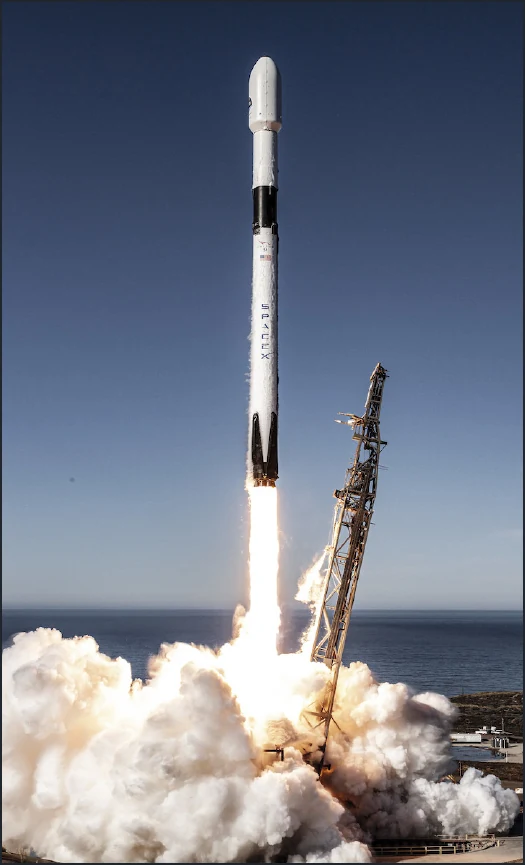
Deployment into orbit.
2 Orbital uncertainty
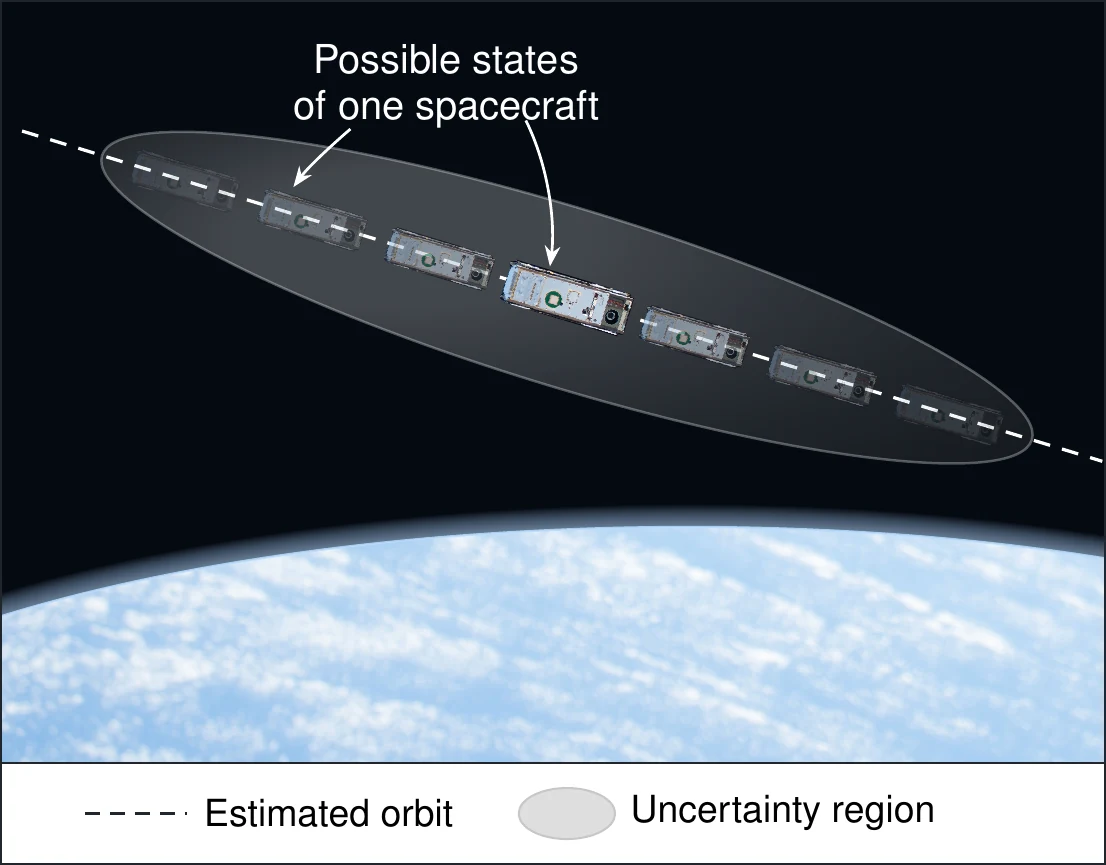
An orbit estimate leaves many possible positions for one spacecraft.
3 Acquisition
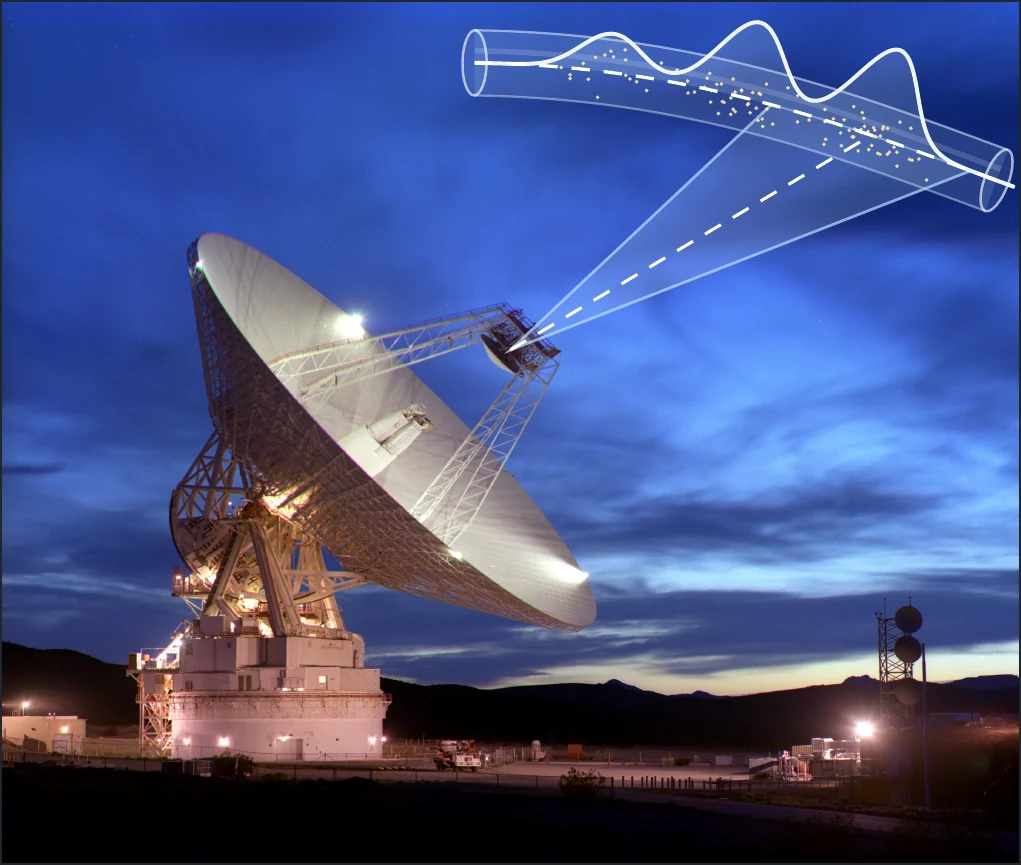
The antenna slews, settles, and listens for the signal.
Abstract
This paper introduces Bayesian Continuation Model Predictive Control (BC-MPC), an adaptive method for finding and establishing contact with spacecraft immediately after launch when their true positions are most uncertain. Launch and deployment errors can leave a spacecraft sufficiently far from its predicted position that operators must actively search during ground contacts. Each missed detection provides information about which orbital hypotheses remain plausible, but searching one part of the uncertainty region can consume the time needed to reach another. BC-MPC updates a particle-based orbital belief after missed detections and replans antenna pointing while retaining a feasible continuation. Across 2,773 attempts from 96 simulated deployments with matched uncertainty, BC-MPC improves acquisition probability over an Along-Track Uncertainty Sweep (ATUS) by 6.9 percentage points and reduces restricted mean acquisition time by 11.5 seconds. We additionally evaluate the method using pre- and post-deployment ephemeris for 83 spacecraft from the Transporter-16 rideshare launch. BC-MPC improves modeled acquisition over ATUS by approximately 12 percentage points under the common assumed uncertainty model.
The problem
Launch and early-orbit operations require operators to establish contact, assess spacecraft health, and transition toward routine communications despite uncertainty in the spacecraft’s position. Launch-vehicle injection errors, deployment dispersion, and atmospheric drag can produce uncertainty that exceeds the antenna beamwidth. Operators must therefore search around the predicted trajectory within limited ground contacts, respecting antenna slew, settling, and receiver timing constraints.
Bayesian Continuation MPC
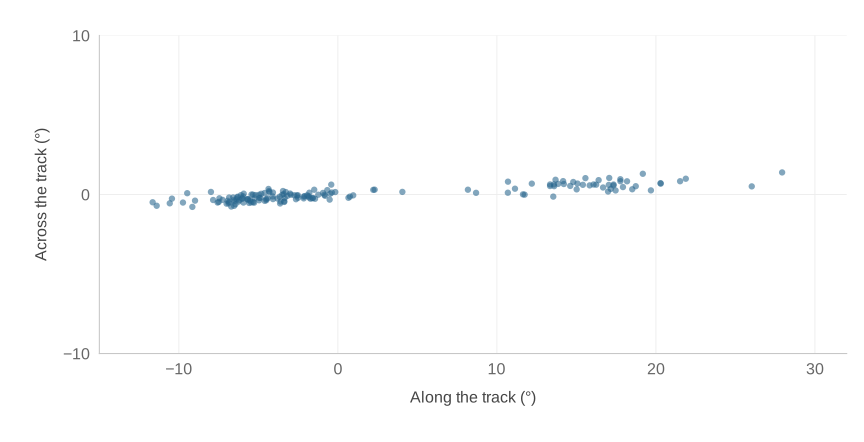
BC-MPC maintains a particle-based belief over possible spacecraft trajectories and updates this belief after missed detections. If a pointing should have produced a detection for a particular orbit hypothesis, a miss reduces that hypothesis’s weight. Antenna motion constraints determine which search actions remain reachable later in the contact.
Starting from a feasible ATUS schedule, BC-MPC reoptimizes the next four antenna pointings while retaining the continuation beyond the planning horizon. Candidate pointings are evaluated together with this continuation over the full remaining contact window. The complete schedule must satisfy antenna motion constraints, including the transition to the retained continuation. Only the first pointing is executed. After a miss, the belief is updated, the optimized schedule is shifted by one stage, and the optimization is repeated.
Results
Single-spacecraft search
We evaluate first-contact acquisition across 2,773 attempts from 96 simulated deployment realizations near an orbit with an altitude of 550 km and an inclination of 97.6°. BC-MPC is initialized from an ATUS schedule with a planning horizon of four dwells and compared against a uniform grid sweep, ATUS, Bayesian greedy, and MPC without continuation. All controllers use a common 192-second search window, matched orbital uncertainty, and antenna motion constraints.
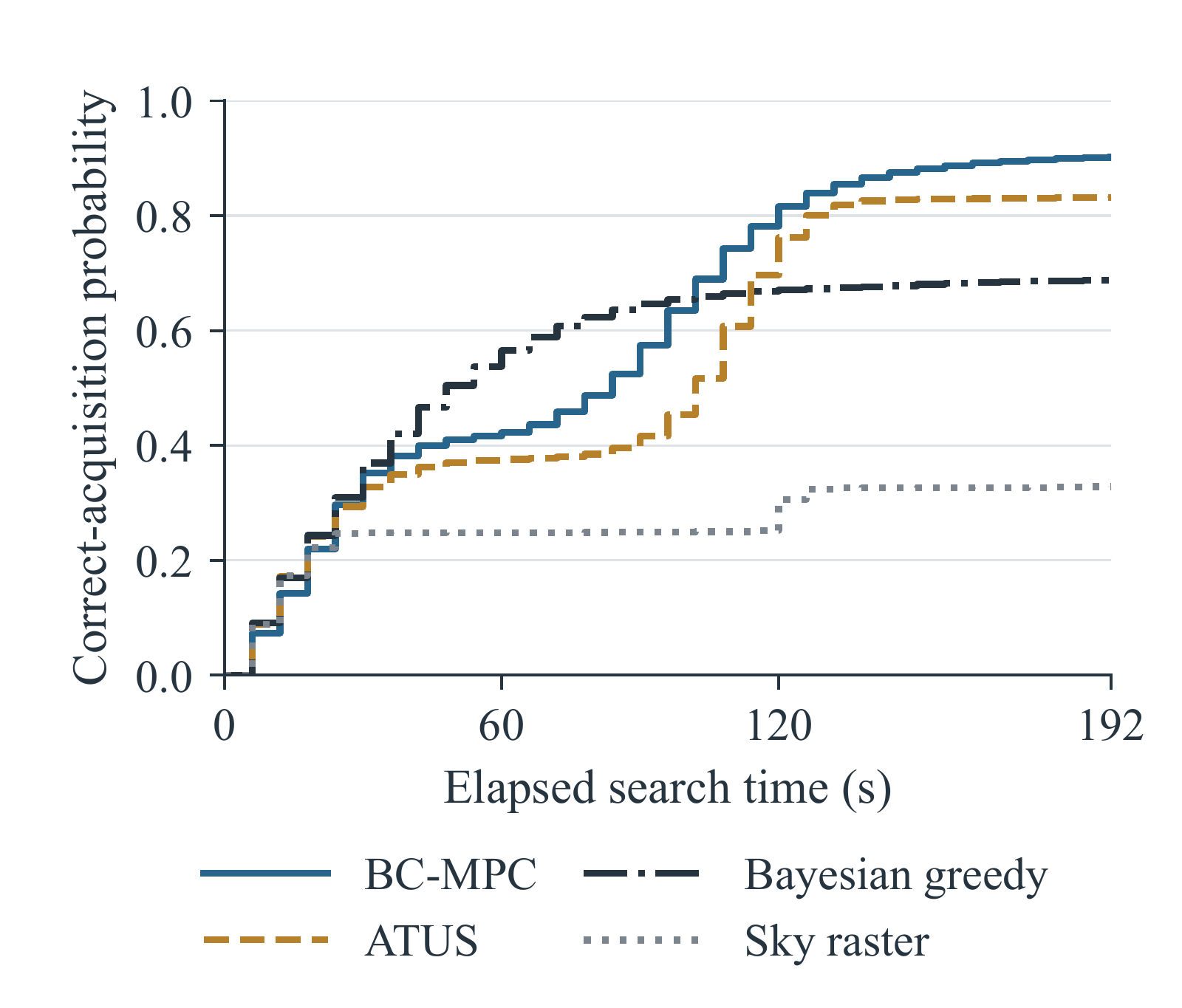
| Controller | Acquired by 60 s (%) | Acquired by 192 s (%) | RMST (s) |
|---|---|---|---|
| Uniform grid | 24.8 | 32.9 | 141.9 |
| ATUS | 37.6 | 83.3 | 89.8 |
| Bayesian greedy | 56.5 | 68.8 | 86.5 |
| MPC, no continuation | 61.4 | 79.0 | 74.5 |
| BC-MPC | 42.3 | 90.2 | 78.3 |
Probabilities are conditional on receiving a reserved contact. Restricted mean acquisition time (RMST) is capped at 192 seconds, with unsuccessful attempts contributing the full duration. The antenna rate and acceleration limits are 1.10 deg/s and 1.00 deg/s².
Fleet acquisition after launch
We investigate whether contact-level improvements translate to improved fleet-scale acquisition. Four simulated deployments each release 100 spacecraft, creating competing acquisition demands across a limited ground-station network. We measure the expected fraction acquired within the first 24 hours as the network expands from one to 24 sites, with four independently steerable antennas per site.
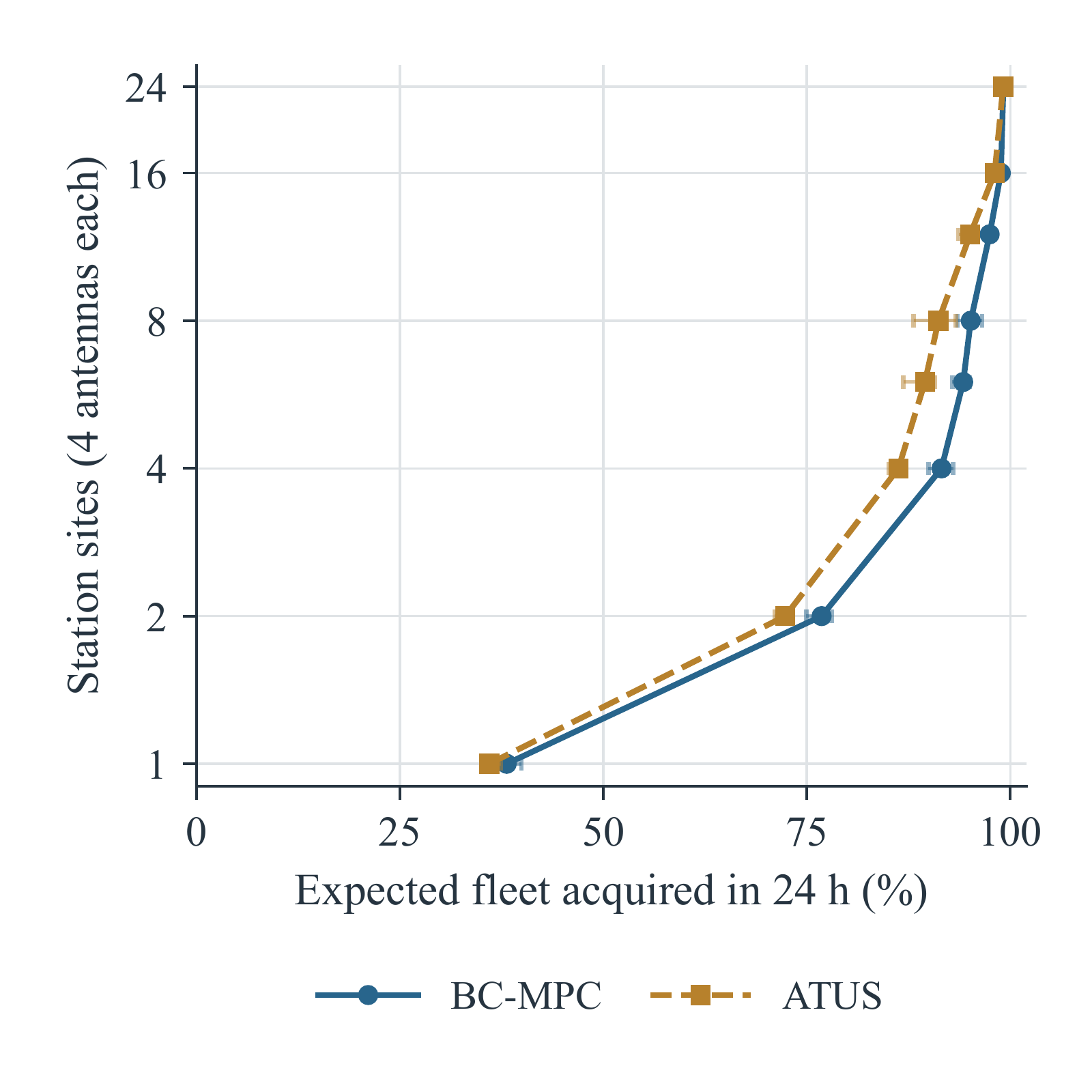
With six sites, the expected fraction acquired within 24 hours increases from 89.5% with ATUS to 94.2% with BC-MPC. The advantage is largest when ground-station opportunities are limited, where a missed acquisition is more difficult to recover from. As the network expands, additional contact opportunities reduce the impact of individual misses and the performance gap narrows. Both controllers approach 99% acquisition for the largest tested network.
These four deployments are separate from the single-spacecraft study. Sites are added in a fixed geographic order. The result is an expected acquired fraction, not the probability of acquiring every spacecraft.
Transporter-16 replay
We evaluate BC-MPC using operational orbit data for 83 spacecraft from the Transporter-16 rideshare launch, supplied by Kayhan Space. The dataset contains pre-deployment ephemeris distributed to operators three days before launch, post-deployment ephemeris, and the first cataloged two-line element set (TLE) correlated to each deployment. The pre- and post-deployment ephemeris represent the orbit products used operationally to cue early ground contacts. The first-catalog TLE is used only retrospectively as an approximate trajectory reference and is unavailable to the controllers.
We evaluate two planning cases, using either pre- or post-deployment ephemeris as controller input, with the same six ground stations and search configuration used in the single-spacecraft evaluation. Both cases yield similar results: BC-MPC improves modeled acquisition over ATUS by approximately 12 percentage points while also reducing restricted mean acquisition time (RMST). The improvement observed in the synthetic evaluation is retained when using operational orbit products.
| Controller | Modeled acquisition (%) | RMST (s) |
|---|---|---|
| Nominal tracking | 4.96 | 184.24 |
| ATUS | 69.51 | 144.05 |
| BC-MPC | 81.55 | 139.10 |
| Controller | Modeled acquisition (%) | RMST (s) |
|---|---|---|
| Nominal tracking | 6.03 | 182.67 |
| ATUS | 68.78 | 144.42 |
| BC-MPC | 81.24 | 139.16 |
Modeled acquisition and RMST use a common assumed uncertainty model with a 20-second phase standard deviation and an approximate first-catalog trajectory reference. Successful searches contribute their time to confirmation; searches without confirmation contribute the full 192-second window.
Explore the solver
LEOPT provides the search solvers and acquisition console. The browser demo includes BC-MPC, the paper’s comparison methods, and two additional baselines. You can edit the sample mission, choose a controller, and step through the search.
The console opens in a separate window. It uses a circular orbit and a reduced search model; the paper’s experiments use SGP4 propagation.
Orbit propagation in the paper is powered by Brahe.
BibTeX
Research manuscript
@unpublished{schreiber2026bayesiancontinuation,
  title  = {Bayesian Continuation {MPC} for Spacecraft Acquisition
            Under Orbital Uncertainty},
  author = {Schreiber, Carlo and Eddy, Duncan and
            Al-Husseini, Mahdi and Woods, Derek and
            Feyzi, Araz and Kochenderfer, Mykel J.},
  year   = {2026},
  note   = {Research manuscript},
  url    = {https://satellite-acquisition.github.io/}
}